The Liang Ma Lab is dedicated to decoding the complex genetic architecture of polygenic brain disorders. Our research mission is to bridge human neurogenetics with cellular and functional neurobiology by identifying how causal genetic variations and mRNA isoforms drive the biological mechanisms of neurodegenerative and neuropsychiatric disorders.
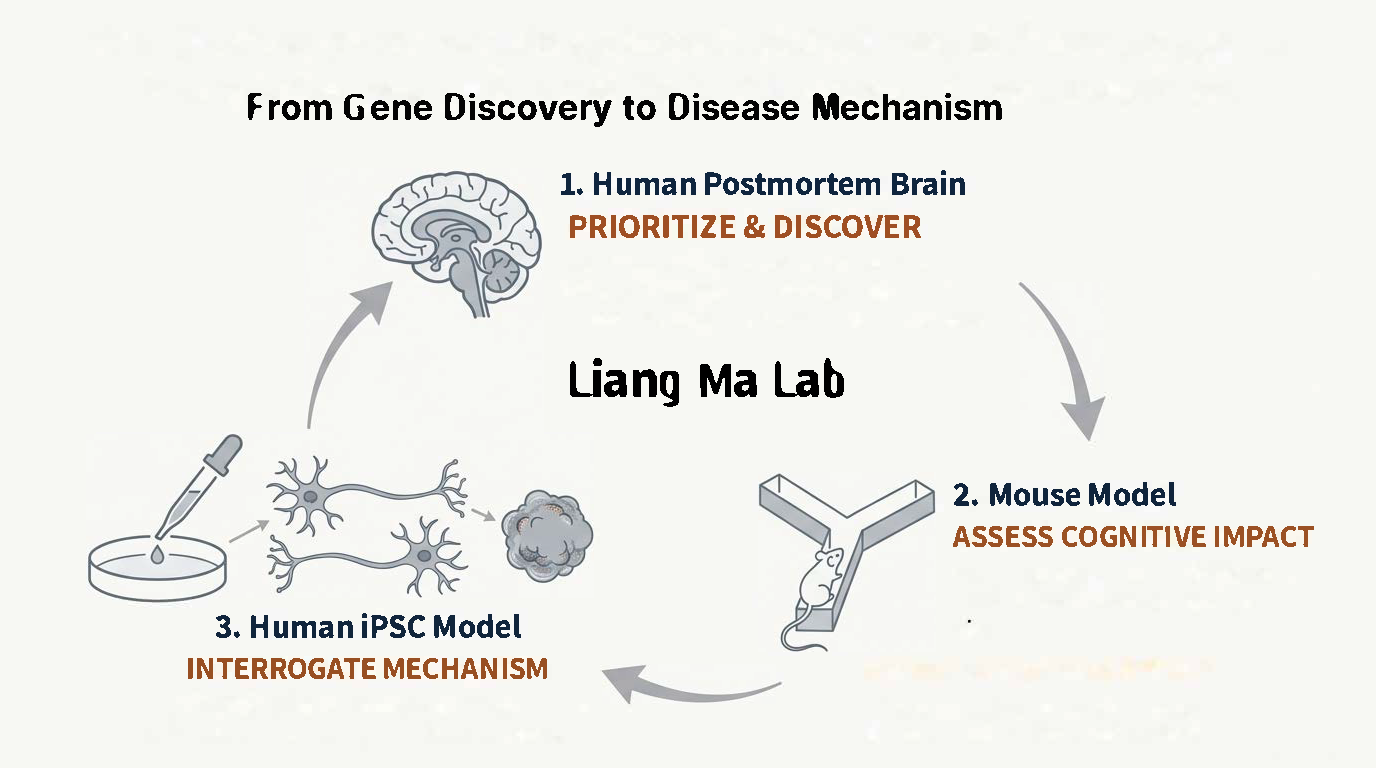
To achieve this, we employ a multi-model strategy that integrates three primary research pillars:
- Human Multi-Omics: We leverage one of the largest datasets of human postmortem brain tissue—including RNA-seq, DNA methylation, and ChIP-seq—to prioritize risk genes and their unique transcript repertoires.
- Advanced Cellular Modeling: Utilizing CRISPR-based genome editing, we generate isogenic human iPSC-derived 2D neurons and 3D brain organoids to mechanistically test how risk genes impact cellular pathways like synaptic integrity.
- In Vivo Validation: In collaboration with other groups, we use mouse models and AAV-mediated gene delivery to assess the impact of prioritized genes on cognitive function, behavior, and synaptic ultrastructure.
Our current major projects focus on SNX19, which regulates glutamate release in excitatory neurons; CYP2D6, a human-specific risk gene that drives mitochondrial dysfunction and oxidative stress; and a novel APOE jxn1.2.2 mRNA isoform that contributes to Alzheimer’s risk independently of traditional genotypes. Additionally, we developed Cell2Spatial, a sophisticated computational framework that reconstructs tissue architecture at single-cell granularity by mapping single-cell data onto spatial transcriptomic spots.