

Lab members attend the annual Dysphagia Research Society meeting (2025)
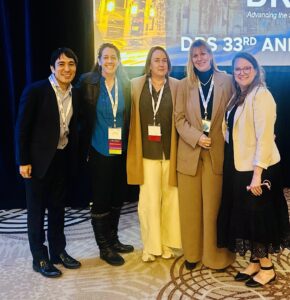
PhD students from the SAUL lab were awarded a podium presentation and a poster presentation at the International Dysphagia Research Society (DRS) meeting, March 25-28th 2025. This meeting showcases the top research in swallowing and swallowing related disorders from around the world. Well done Team!
Current Projects
DOD SwallowFit Study Awarded

“SwallowFIT” an exercise program for US service members, Veterans, and family with Parkinson’s Disease: randomized clinical trial.
The goal of this 3-year double blind randomized clinical trial is to test a preventative behavioral swallowing exercise program called “SwallowFIT”.
This study will explore if early swallowing exercise improves function and reduces adverse outcomes for persons with PD.
Specific aims are to a) evaluate the effectiveness of a proactive swallow exercise program [SwallowFIT] in US Service members, Veterans and family members With Parkinson’s Disease and b) determine the acceptability, adherence and longer-term maintenance of swallowing fitness following the SwallowFIT program.
Evaluation of an intensive swallow exercise therapy for maintaining feeding and well-being in persons with Parkinson's disease

This study is a pilot pre-post interventional swallowing therapy study with 1 month follow up of persons with Parkinson’s Disease. The overarching objective in this study is to evaluate an established swallow exercise intervention [McNeil Dysphagia Therapy Program: MDTP] that is simple, accessible, pleasurable, and engages patients and families, to promote swallow fitness to optimize swallow function longer into PD progression.
Intervention for Upper Esophageal Sphincter Dysfunction

Upper esophageal sphincter (UES) dysfunction, defined as inappropriate opening or failed relaxation of the UES during swallowing, is a common cause of dysphagia. This research project consists of two parts: I- a systematic review of the literature to assess UES intervention trends and their impact on patient outcomes. II- Development of a multi-site study to explore the comparative effectiveness of two common intervention types.
"Dysphagia: In Search of a Unified Definition for the Aging Population: NIH R-13 study"

Despite the high incidence and prevalence of dysphagia, particularly in the adult aging population, there is no uniform definition of adult dysphagia. Instead, heterogenous definitions in the extant literature pave the way for ambiguity and philosophical differences among dysphagia experts and other key stakeholders. Establishing an accepted and cogent definition for dysphagia is a critical step in quantifying the exact magnitude of disease in a specific population and assuring accuracy and consistency across healthcare settings, researchers, third party payers, and other key stakeholders.
The aim of this NIH directed research and conference therefore is to engage experts and key stakeholders who work with older adults with dysphagia and to collaborate and develop a consensus validation for a unified definition of dysphagia and guidelines that can be applied for use in clinical patient populations, public health, and policy.
Student Projects
A Pilot Study of Oral Microbiome Changes Following Intense Swallowing Therapy in Parkinson's Disease

Oral microbiota differs between PD patients and healthy individuals. The aim of this pilot study is to evaluate changes in the oral microbial environment following normalization of oral feeding through intensive swallowing therapy in PD.
Spontaneous swallowing frequency in Parkinson’s Disease (PD) reflects swallow integrity: a case-control study

When spontaneous swallowing (SSF), an innate protective mechanism, is impaired, aspiration prevalence and the risk of pneumonia are increased, especially in individuals with dysphagia. Data on SSF change and its significance in Parkinson’s disease are unknown. This study compared SSF rates in a cohort of early PD patients to age and gender-matched healthy controls.
Intervention for Upper Esophageal Sphincter Dysfunction: A Systematic Review

Upper esophageal sphincter (UES) dysfunction, defined as inappropriate opening or failed relaxation of the UES during swallowing, is a common cause of dysphagia. The primary aim of this review was to assess UES intervention trends and their impact on patient outcomes.